
Stablecoin Under Real FX Influence While Tether Pushes Real Open‑Source Mining Tools
Stablecoins’ role as a crypto-trading tool is shifting, as mainstream financial infrastructure enables seamless global payments, builds treasuries, and supports AI-driven commerce. It is also transforming into foreign exchange (FX) as it allows 24/7, instant, and low-cost cross-border transactions. It has the potential to replace traditional correspondent banking.
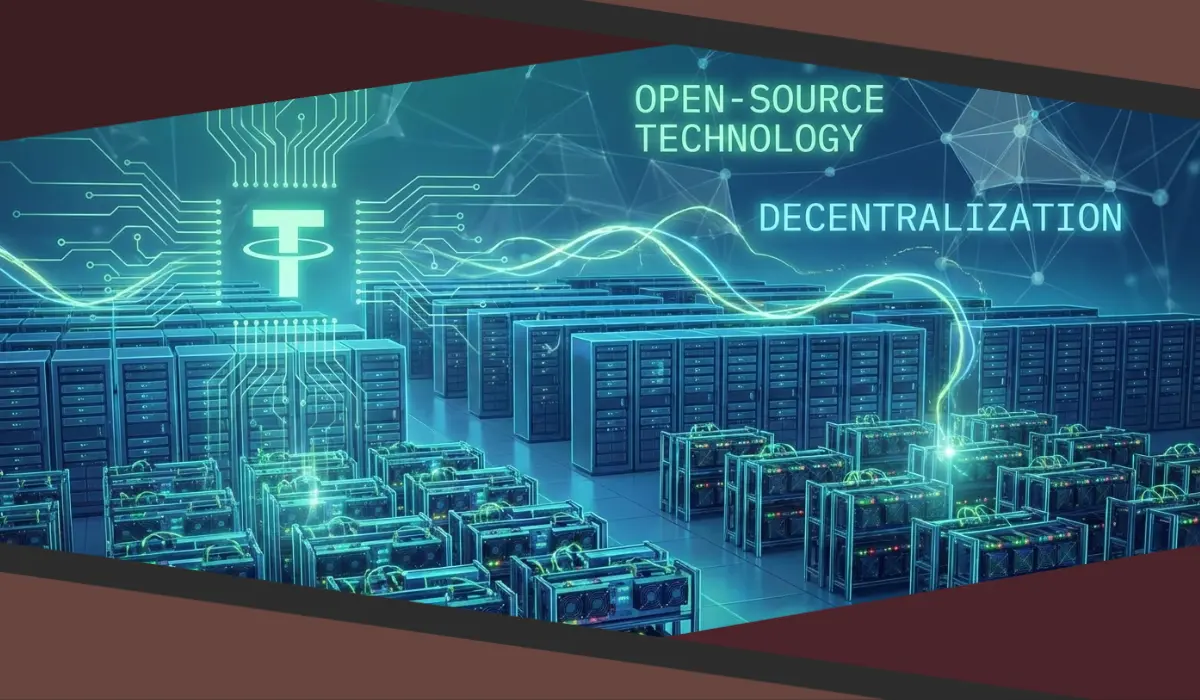
Recently, Tether, the largest stablecoin issuer, announced the launch of an open-source operating system designed for Bitcoin mining. The software is called MiningOS (MOS), and unlike other systems, MOS is free, open to inspection, and designed to operate without centralized control.
Currently, the Bitcoin mining industry is dominated by a large, well-capitalized set of people. Tether has not designed a tool that helps reduce the complexity and cost of Bitcoin mining. It not only simplifies and scales mining but also supports decentralization across the industry.
Tether wrote on its MiningOS website, “The mining industry has long been limited by closed systems and proprietary tools. MiningOS changes that — introducing transparency, openness, and collaboration into the core of Bitcoin infrastructure. No black boxes. No lock-in. No Limits.”
What Do We Know About MiningOS?
According to Tether, MiningOS is released under the Apache 2.0 open-source license, which can be used, modified, and distributed freely. It is built on Holepunch peer-to-peer protocols, enabling direct communication between devices. It does not have to rely on centralized services or third-party dependencies.
Tether’s MiningOS has a self-hosted mining architecture that communicates with other devices via an integrated peer-to-peer network. It also allows operators to manage mining infrastructure locally rather than managing it through external cloud-based servers.
This new technology improves reliability, transparency, and privacy for miners. It also has management features, allowing miners to adjust settings based on scale and output requirements. This operating system supports monitoring of hardware performance, energy usage, cooling systems, and site operations through a single interface.
Why Tether Introduced MiningOS?
Rather than being a platform that facilitates the issuance and transactions of stablecoin, Tether has been working towards more functions, such as mining, energy infrastructure, and artificial intelligence.
The timing is also crucial as Bitcoin mining has become much more difficult, especially after the recent halving that cut block rewards. In a highly competitive environment, miners have to cut software costs and gain operational efficiencies.
Challenging Established Mining Firms
In cryptocurrency mining, those who control the system’s functions hold total power. An open-source alternative, such as Tether’s MiningOS, allows miners to audit the code, customize it according to specific environments, or adapt it to unusual power setups.
It is valuable for small and mid-sized miners. This platform also removes software fees and provides much more adaptability. As we know, Bitcoin’s security depends on the hash power. Even small improvements that help independent miners stay in the game make the whole network much stronger in the long run.
Limitation of MiningOS
Tether’s MiningOS may not be a miracle, as mining remains a capital-intensive energy-dependent process. This platform does not resolve the high energy requirements, hardware supply, and regulatory obstacles.
MiningOS has to validate its usability and efficiency in real-world applications. As the question of safety remains, miners and developers might be concerned about its effectiveness and not engage until it gains traction and builds an active community.
Market Reaction To MiningOS
Tether’s new mining tool, MiningOS, has built interest among crypto communities. As mentioned before, its adoption depends on the platform’s performance, security, and integration capabilities. If the platform gains traction, it would face the established mining tools and compete with existing players. Analysts are also looking forward to regulatory developments that can influence open-source mining tools. They are also monitoring Tether’s expanding role in both stablecoin issuance and the development of mining infrastructure.
Bottomline
Tether’s new mining platform, MiningOS, has received investor attention. Analysts are observing whether Tether’s new expansion into mining infrastructure strengthens its market position by ensuring innovation, transparency, and reliability.
